

DECNO Advances Sustainable Flooring Solutions with Verified Product Carbon Footprint Assessment.
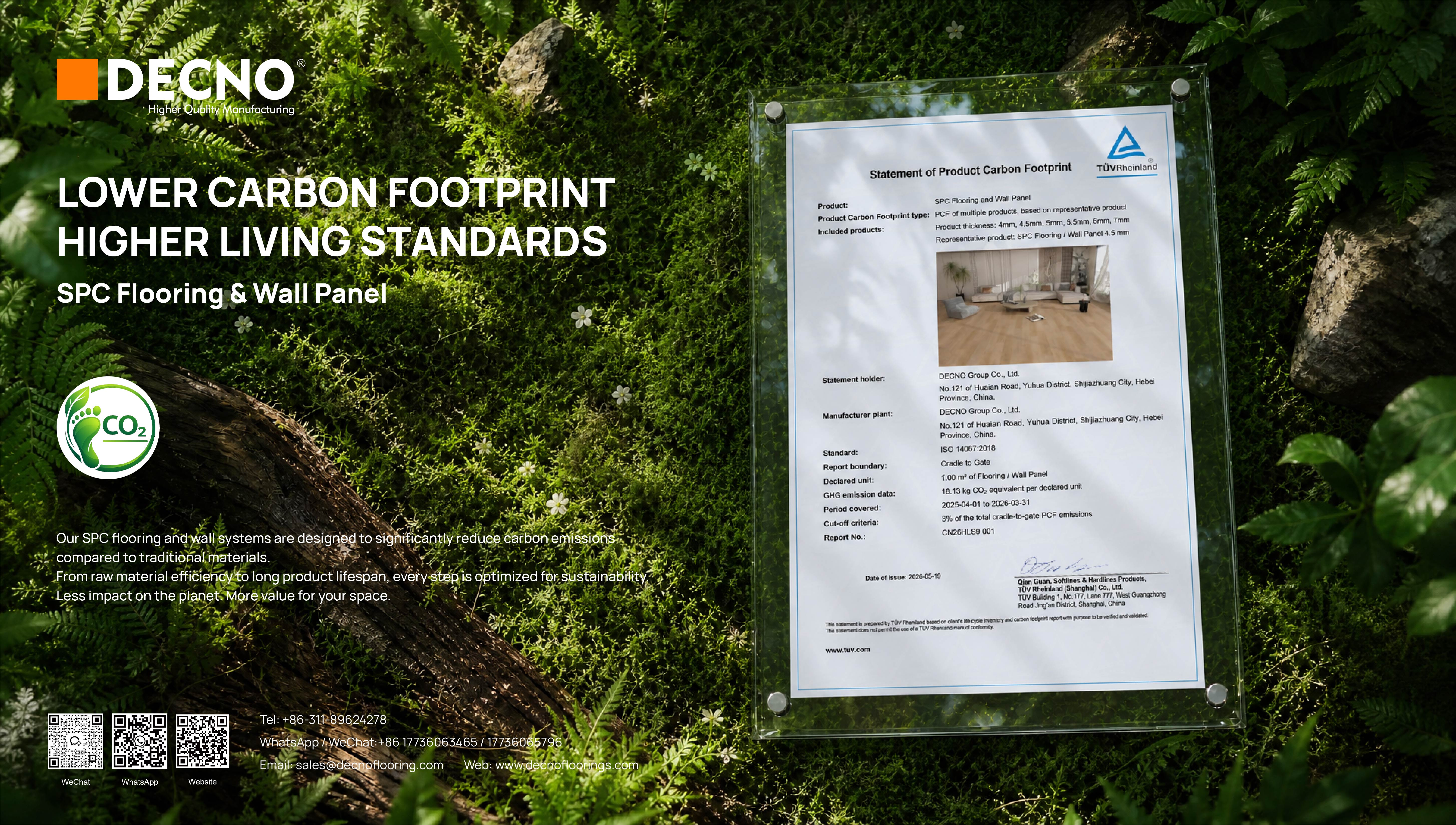
As global demand for sustainable building materials continues to grow, DECNO is proud to announce the successful completion of a comprehensive Product Carbon Footprint (PCF) assessment for its SPC Flooring and SPC Wall Panel product range. The study was independently conducted by TÜV Rheinland in accordance with ISO 14067:2018, the internationally recognized standard for quantifying greenhouse gas emissions associated with products throughout their lifecycle.
This achievement marks another important milestone in DECNO’s sustainability journey and reinforces the company’s commitment to providing environmentally responsible flooring and wall panel solutions for customers worldwide.
Supporting Global Sustainability Goals
The construction and building materials industry is undergoing a major transformation driven by stricter environmental regulations, carbon transparency requirements, and growing market demand for sustainable products. Across Europe and other international markets, carbon footprint data and Environmental Product Declarations (EPDs) are increasingly becoming key requirements for commercial projects, public procurement, green building certifications, and ESG reporting.
To support these evolving market expectations, DECNO has invested in environmental assessment and lifecycle analysis programs that provide transparent and reliable environmental performance data for its products.
Today, DECNO offers customers not only high-quality SPC flooring and wall panel solutions but also verified environmental documentation that supports sustainable construction projects.
Verified Carbon Footprint Results
According to the Product Carbon Footprint Study Report, the representative 4.5mm SPC Flooring product achieved a carbon footprint value of 18.13 kg CO₂e per square meter under a cradle-to-gate assessment boundary.
The study covered raw material extraction, transportation, manufacturing processes, energy consumption, and packaging activities. The assessment was based on actual production data collected from DECNO’s manufacturing operations and analyzed using internationally recognized lifecycle assessment methodologies.
The report identified electricity consumption, PVC resin, wear layer materials, and calcium carbonate as the primary contributors to the product’s overall carbon footprint. These findings provide valuable insights for future carbon reduction initiatives and continuous environmental improvement.
Continuous Improvement Through Innovation
The carbon footprint assessment also highlighted significant opportunities for further emissions reduction.
Scenario analysis conducted during the study demonstrated that increasing the use of renewable energy could substantially reduce the overall carbon footprint of SPC flooring products. Under a 100% photovoltaic (PV) electricity scenario, the product carbon footprint could be reduced by approximately 36%, demonstrating the strong potential of clean energy integration within manufacturing operations.
As part of its long-term sustainability strategy, DECNO continues to explore:
Energy efficiency optimization throughout production processes
Increased use of renewable energy sources
Sustainable raw material selection
Resource utilization improvement
Waste recycling and circular manufacturing practices
Supply chain environmental collaboration
Closed-Loop Manufacturing and Resource Efficiency
Environmental responsibility is integrated throughout DECNO's production system.
During manufacturing, production scraps and defective materials generated from SPC flooring and wall panel production are collected, processed, and reintroduced into production through internal recycling systems. This closed-loop approach helps reduce waste generation while improving resource utilization efficiency.
By continuously improving manufacturing technologies and operational efficiency, DECNO seeks to reduce environmental impacts while maintaining the high product quality standards expected by global customers.
Supporting Green Building Projects Worldwide
In addition to its Product Carbon Footprint assessment, DECNO has also obtained Environmental Product Declaration (EPD) certification and continues to maintain a comprehensive environmental and quality management system.
Combined with certifications such as ISO 9001, ISO 14001, ISO 45001, CE, FloorScore, and third-party testing programs, DECNO provides customers with reliable environmental and technical documentation that supports:
Green building certification projects
Sustainable commercial developments
Residential construction projects
Hospitality and retail applications
ESG and corporate sustainability initiatives
Looking Ahead
Sustainability is no longer a future trend—it is a fundamental requirement for modern construction and interior design industries.
As a global manufacturer serving customers in more than 80 countries and regions, DECNO remains committed to innovation, environmental responsibility, and long-term sustainable growth.
Through verified carbon footprint assessments, EPD certification, advanced manufacturing technologies, and continuous environmental improvement, DECNO is helping customers build healthier, more sustainable, and future-ready spaces around the world.
DECNO is a professional manufacturer specializing in SPC flooring, SPC wall panels, laminate flooring, and integrated flooring and wall solutions. With multiple production bases, advanced manufacturing facilities, and a strong focus on quality and sustainability, DECNO provides OEM and ODM services for flooring brands, distributors, importers, and construction material partners worldwide.
Together, we are building a more sustainable future—one floor at a time.DECNO Strengthens Its Commitment to Low-Carbon Manufacturing and Environmental Transparency.


 Español
 Alemán
 عربى
عربى Français